
Step into History at Hagia Sophia
Byzantine cathedral turned mosque, with 1,500 years of history under one dome
Hagia Sophia was built in 537 AD under the Byzantine emperor Justinian I, and for nearly a thousand years it was the largest cathedral in the Christian world. It has since been a church, a mosque, a museum, and a mosque again. That layered past is the reason to go: golden Christian mosaics survive alongside Ottoman calligraphy, and nowhere else puts the two traditions in one room at this scale. From the upper gallery, look up into the main dome. Then take your time with the rest, the marble, the upper galleries, the way the light moves through the space. Few buildings anywhere have been fought over, prayed in, and rebuilt for so long, and you can read most of that history on its walls.
Hagia Sophia is a working mosque again since 2020. Visitors are welcome, but they use a separate visitors’ entrance and see the building from the upper gallery, and it closes to visitors during prayer times. Plan your visit around them and you will have a far calmer experience.
What to see inside
- The great dome: more than 30 metres across and ringed by forty windows, so it seems to float on light. For almost a thousand years it was the largest cathedral in the world.
- Byzantine mosaics: look for the golden Deësis mosaic in the upper gallery, with Christ between the Virgin Mary and John the Baptist, and the portraits of emperors and empresses nearby.
- Ottoman additions: the huge round calligraphy medallions, the mihrab facing Mecca and the marble minbar were added after 1453, when the church became a mosque.
- Marble and columns: coloured marble from all over the Roman world, and the “weeping column”, which visitors traditionally touch for luck.
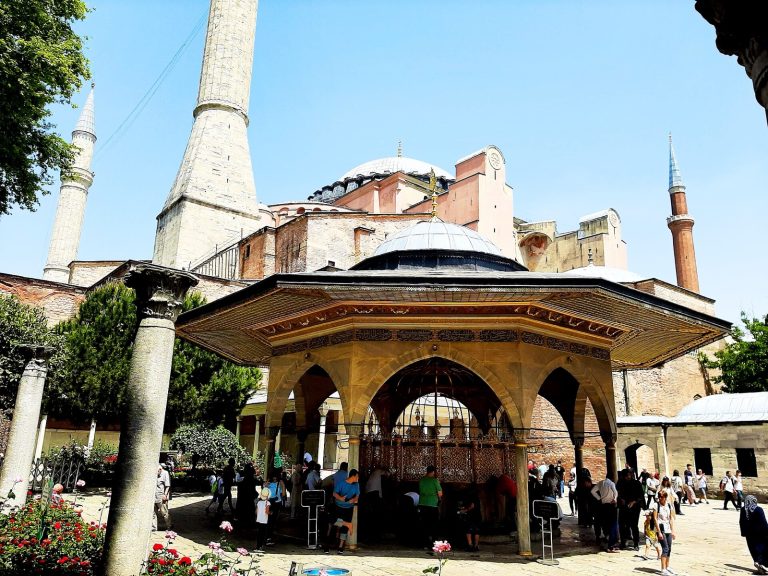
- The outside: the four minarets and the heavy buttresses tell the story of a building that has been strengthened again and again over 1,500 years.
Visiting tips
- Go early. Queues build up quickly from mid-morning, especially in summer and on weekends.
- Avoid prayer times, especially the Friday noon prayer, when the building closes to visitors for longer.
- Dress modestly: shoulders and knees covered; women cover their hair. Scarves are usually available at the entrance.
- Entry fee: foreign visitors pay an entry fee. It changes from time to time, so check the current price before you go and carry a card or cash.
- Take a guide if you can: the history and the mosaics make much more sense with someone to point them out, and guided tours often save time at the entrance.
- Photos without flash are fine; be respectful of people praying.
What’s nearby
The Blue Mosque faces Hagia Sophia across the gardens of Sultanahmet Square, and the Basilica Cistern is two minutes away on foot. Topkapı Palace begins right behind Hagia Sophia, and the Grand Bazaar is about a 15-minute walk. Together they make a perfect first day in Istanbul.
What visitors say
Recent visitors keep sharing the same practical advice:
- Buy your ticket from the official source. Foreign visitors need a ticket, and many look-alike websites sell them at a mark-up. Buy your ticket at the official ticket office by the entrance.
- Go early. The queue at the ticket booth can take a long time in high season; the first hours after opening are the calmest.
- Check prayer times. Hagia Sophia is a working mosque and closes to visitors for about half an hour before and after each of the five daily prayers. On Fridays, visits only start after midday prayers.
- Dress for a mosque. Shoulders and knees covered; women cover their hair (scarves are available at the entrance).
- Everyone goes through security, even with a fast-track ticket.
- Allow about an hour, and combine it with the Blue Mosque and the Basilica Cistern, which are only a few minutes’ walk away.
Hagia Sophia: frequently asked questions
Is Hagia Sophia a mosque or a museum?
It is a mosque. Hagia Sophia was a church for about 900 years, a mosque from 1453, a museum from 1934 and became a mosque again in 2020. Visitors are still welcome outside prayer times.
Do tourists have to pay to enter Hagia Sophia?
Yes. Foreign visitors pay an entry fee and visit the upper gallery through a separate entrance. The price changes from time to time, so check before your visit.
How long does a visit take?
Plan about one to two hours, plus waiting time at the entrance in busy months. Arriving early in the morning is the best way to avoid long queues.
What should I wear to Hagia Sophia?
Cover your shoulders and knees. Women should cover their hair; scarves are usually available at the entrance. Shorts and sleeveless tops are not allowed.
Book tours & tickets
🎟️ See Hagia Sophia tours & tickets →Free cancellation on most tours · secure booking with GetYourGuide
Photos: MilenaBal, CC BY-SA 4.0; ImanFakhri, CC BY-SA 4.0, via Wikimedia Commons
No visitor reviews for this place yet. Have you been here? Rate it and help other travellers.
Share your experience →Share your memories and tips with other travellers. Your story will appear on our blog with your name.