
Istanbul Archaeology Museums: A Visitor Guide
Three historic buildings next to Topkapı Palace and Gülhane Park
In short: the Istanbul Archaeology Museums are three museums in one complex beside Gülhane Park and Topkapı Palace: the main Archaeological Museum, the Museum of the Ancient Orient and the Tiled Kiosk. Highlights include the Alexander Sarcophagus and the Sarcophagus of the Mourning Women. The complex is open every day, it is included in the Museum Pass Istanbul, and the nearest stop is Gülhane on the T1 tram. Allow two to three hours.
Last checked: 11 November 2026. Opening hours can change in winter and on religious holidays; check the official Ministry of Culture museum site before you go.
One of the world’s great archaeology collections
The collection began in 1869 as the Imperial Museum, first kept in the Byzantine church of Hagia Irene. In 1881 the painter and archaeologist Osman Hamdi Bey became its director, and he is regarded as the museum’s founder. His excavations at Sidon (in today’s Lebanon) in 1887–88 uncovered a royal necropolis, and the great sarcophagi found there needed a building of their own.
That building is the neoclassical main museum, designed by the architect Alexandre Vallaury and opened in 1891. Its façade was inspired by the sarcophagi it was built to house.
The three museums
- Archaeological Museum (main building): the Sidon sarcophagi, Greek and Roman sculpture, and large galleries on the archaeology of Istanbul and its surroundings. The building was restored from 2011 and fully reopened in 2021.
- Museum of the Ancient Orient: built in 1883 as the Academy of Fine Arts and opened as a museum in 1935. It holds finds from Mesopotamia, Anatolia, Egypt and the Arabian Peninsula. Closed for restoration in 2022, it reopened on 6 July 2026.
- Tiled Kiosk (Çinili Köşk): built in 1472 for Sultan Mehmed II, it is one of the oldest Ottoman buildings in Istanbul and became the museum’s first home in 1880. It shows Seljuk and Ottoman tiles and ceramics, including İznik, Kütahya and Çanakkale ware. Its galleries were recently redisplayed and its façade tiles conserved.
Highlights not to miss
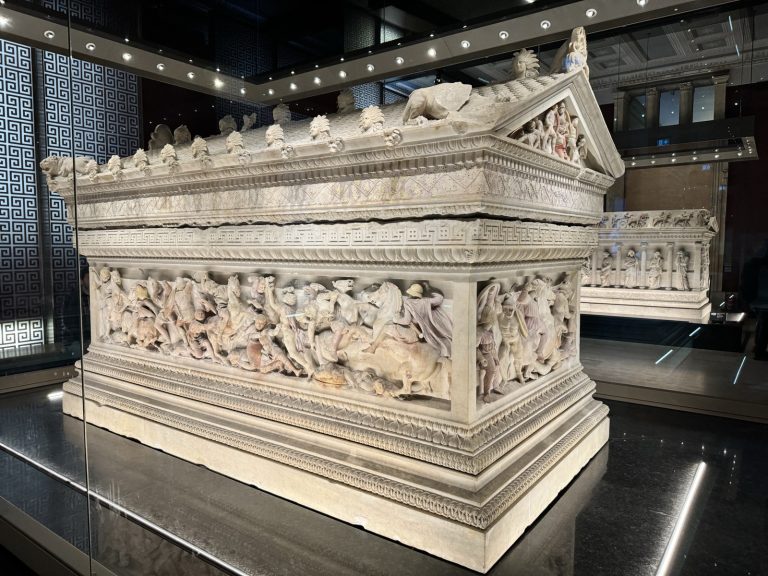
- The Alexander Sarcophagus: found at Sidon and named after the battle and hunting scenes with Alexander the Great carved on its sides. It is the best-known piece in the museum.
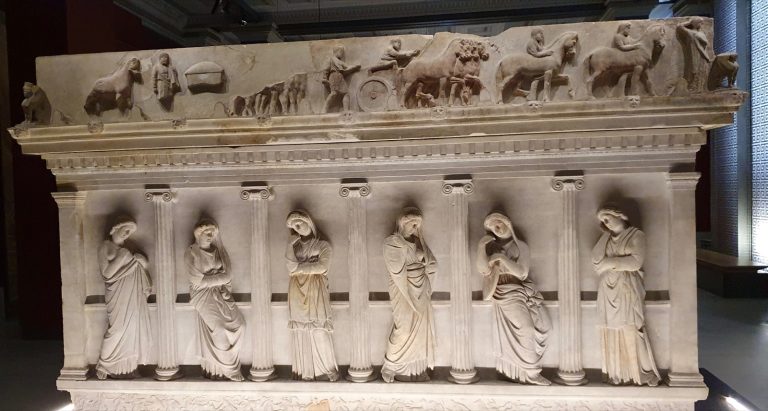
- The Sarcophagus of the Mourning Women: also from Sidon, carved like a small temple with mourning women standing between its columns.
- The Treaty of Kadesh tablet: in the Museum of the Ancient Orient, a clay tablet recording the peace treaty between the Egyptians and the Hittites, often described as one of the oldest known written peace treaties.
- Glazed-brick panels from Babylon: lions, bulls and dragons from the Ishtar Gate and the Processional Way, also in the Museum of the Ancient Orient.
- The Tiled Kiosk itself: look at the tiled entrance portico as well as the ceramics inside.
The museum also owns famous inscriptions such as the Siloam inscription and the Gezer calendar. The galleries have been rearranged in recent years, so we could not confirm which of these are on display today.
Getting there and getting in
- Where: Osman Hamdi Bey Yokuşu, Gülhane, in Fatih on the Historic Peninsula, between Gülhane Park and the outer court of Topkapı Palace.
- By tram: take the T1 tram to Gülhane and walk about five minutes; Sultanahmet is one stop further. See getting around Istanbul.
- New entrance: the main entrance has moved to Gülhane Square, with a new visitor centre (announced in September 2026). Around 38 ancient pieces now line the Osman Hamdi Bey slope, and around 140 stand in the redesigned courtyard.
- Opening days: the museum is open every day, and there is no weekly closing day. Hours change in winter and on religious holidays.
- Museum Pass Istanbul: the museum is included in the pass.
Visiting tips
- Combine it with Topkapı: the museum, Topkapı Palace and Gülhane Park are next to each other, so they fit into the same half-day.
- Plan your day with our three days in Istanbul itinerary, which also covers Hagia Sophia and the Basilica Cistern.
Book tours & tickets
🎟️ See all tours →Free cancellation on most tours · secure booking with GetYourGuide
Sources we checked (November 2026): Ministry of Culture and Tourism: Istanbul Archaeology Museums · Wikipedia: Istanbul Archaeology Museums · Anadolu Agency: museums renewed (Sept 2026) · Daily Sabah: restoration revives the museums · GZT: Museum of the Ancient Orient reopens (Turkish) · Türkiye Today: inside the reopened Museum of the Ancient Orient · Habertürk: the museums’ transformation (Turkish) · Istanbul Clues: Museum Pass · Frommer’s: Archaeology Museum · Metro Istanbul: T1 tram · Museum Pass Türkiye (official) · Euronews: Archaeology Museums transformation (Turkish)
Istanbul Archaeology Museums: questions
Which day are the Istanbul Archaeology Museums closed?
There is no weekly closing day; the museums are open every day. Hours change in winter and on religious holidays, so check the official Ministry of Culture site before you go.
Is the museum included in the Museum Pass Istanbul?
Yes, the Istanbul Archaeology Museums are included in the Museum Pass Istanbul.
How long do I need?
Allow about two to three hours to see all three buildings: the main Archaeological Museum, the Museum of the Ancient Orient and the Tiled Kiosk.
How do I get there?
Take the T1 tram to Gülhane and walk about five minutes. The main entrance has moved to Gülhane Square.
Is everything open after the restoration?
The main building has been open since 2021 and the Museum of the Ancient Orient reopened on 6 July 2026. The Tiled Kiosk has been restored and redisplayed; check on arrival which rooms are open.
Header photo: the Tiled Kiosk (Çinili Köşk). Photo: José Luis Filpo Cabana, CC BY 3.0, via Wikimedia Commons (resized).
No visitor reviews for this place yet. Have you been here? Rate it and help other travellers.
Share your experience →Share your memories and tips with other travellers. Your story will appear on our blog with your name.