
Knidos: The Ancient City at the Tip of the Datça Peninsula
Two harbours, two theatres and the city of Praxiteles’ famous Aphrodite
In short: Knidos lies at Tekirburun, the very tip of the Datça Peninsula, about 35 km west of Datça town. It was a rich Greek port city with two harbours, two theatres, temples and a long necropolis, and it was famous across the ancient world for the Aphrodite of Praxiteles. In 2025 it was the most-visited ancient site in Muğla province. The site is open every day.
Last checked: 10 November 2026, against the official Turkish Museums listing. Winter hours apply from 16 October to 1 May.
A city between two seas
Knidos was one of the six cities of the Dorian Hexapolis, a league of Greek cities on this coast. The city was built partly on the mainland and partly on a small island; when the channel between them was filled in, it left two harbours: a small northern harbour for warships and a large southern harbour for trade. Ships sailing between the Aegean and the Mediterranean called here, and the city grew rich.
Knidos is best known for a statue: in the 4th century BC the sculptor Praxiteles made an Aphrodite showing the goddess nude, a bold innovation at the time. The people of Kos are said to have refused it, and Knidos bought it; visitors came from far away to see it. The original is lost, but Roman copies survive, the best known in the Vatican Museums. The astronomer Eudoxus worked at Knidos, and the city was also the home of Sostratos, the architect of the Pharos, the great lighthouse of Alexandria.
What to see
- The two harbours: still clearly visible from the hillside.
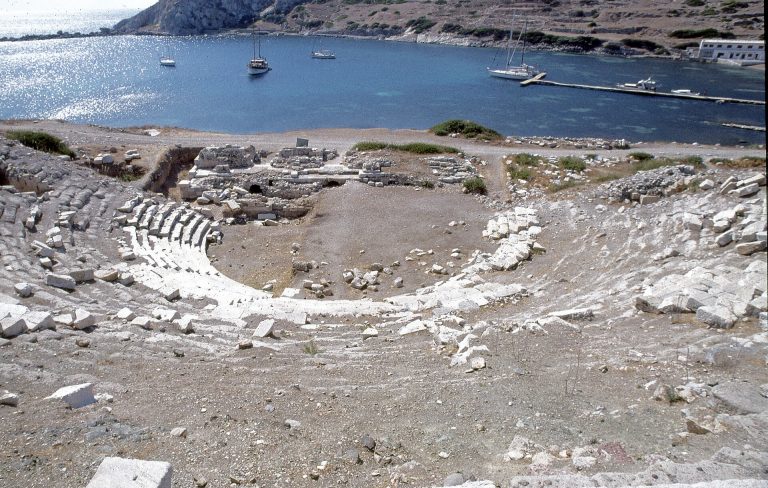
- The theatres: a lower theatre near the harbours and an upper theatre on the slope, plus a small odeon.
- The round temple: a circular temple with Corinthian capitals on a terrace above the sea; it is often linked with the cult of Aphrodite.
- Temples and sanctuaries: remains of temples of Dionysos and Apollo Karneios, a sanctuary of Demeter and a Hellenistic sundial.
- Churches and necropolis: several early churches, and tombs stretching for kilometres along the road into the city.
Excavations and the 2026 works
Excavations at Knidos have a long history, from the British archaeologist C. T. Newton in the 1850s to today’s Turkish team from Selçuk University, working here since 2012. In June 2026 the Ministry of Culture and Tourism completed new works at the site, with a larger car park, repairs along the shore and new visitor routes.
Visiting tips
- Opening hours: every day. Summer (1 May to 15 October) 08:30 to 20:00, last tickets 19:30; winter 08:30 to 17:30, according to the official listing.
- Facilities: a restaurant, toilets and a car park.
- Bring: water, a hat and good shoes; the site is large and open to the sun and wind.
- Time needed: two to three hours, or half a day if you want to swim afterwards.
Getting there
- By car: about 35 km west of Datça town on a winding road; part of the final stretch may be unpaved, so drive slowly.
- By boat: in the tourist season, boats and yachts also call at Knidos.
- See our Datça guide for getting to the peninsula.
What real travellers say
- “The setting is unbeatable.” Ruins, two bays and open sea all around.
- “Go late in the day.” Many love the light and the sunset at the tip of the peninsula.
- “The drive is part of the adventure.” The road passes wild, quiet countryside.
Summarised in our own words from travel guides and holidaymaker reviews. We don’t list prices because they change often.
Sources we checked (November 2026): Turkish Museums: Knidos · Britannica: Aphrodite of Cnidus · Hürriyet Daily News: Knidos · NTV: 2026 site works (Turkish) · Hürriyet Daily News: Muğla visitor figures 2025
Knidos: questions
How far is Knidos from Datça?
About 35 km west of Datça town, at the tip of the peninsula, reached by a winding road.
Is Knidos open every day?
Yes. In summer (1 May to 15 October) it is open 08:30 to 20:00, and in winter 08:30 to 17:30.
Can I see the Aphrodite of Knidos?
The original statue by Praxiteles is lost; Roman copies survive in museums, the best known in the Vatican.
Header photo: the theatre of Knidos above the harbour. Photo: Vadim Indeikin, CC BY-SA 3.0, via Wikimedia Commons
No visitor reviews for this place yet. Have you been here? Rate it and help other travellers.
Share your experience →Share your memories and tips with other travellers. Your story will appear on our blog with your name.