
Dolmabahçe Palace: The Last Home of the Sultans on the Bosphorus
Crystal, gold and the room where Atatürk died, on the European shore of the Bosphorus
In short: Dolmabahçe Palace was the main palace of the Ottoman sultans from 1856 (except in 1877–1909, when Sultan Abdülhamid II ruled from Yıldız Palace), and it is where Mustafa Kemal Atatürk, founder of the Republic, died on 10 November 1938 at 09:05. Visits are by ticket to the state rooms (Selamlık) and the private quarters (Harem). The palace is closed on Mondays, and it is not included in the Museum Pass.
Last checked: 10 November 2026, against the official National Palaces (Milli Saraylar) website. Opening times change between summer and winter, so check before you go.
A short history
The palace was built for Sultan Abdülmecid on the site of an older waterfront palace in Beşiktaş, and the court moved in in 1856, leaving Topkapı Palace behind. The architects were members of the Balyan family, Istanbul’s best-known builders of the 19th century. Six sultans and the last caliph lived here. After the Republic was founded, Atatürk stayed at the palace on his visits to Istanbul, and he died here on 10 November 1938. Every year at 09:05 on 10 November, the whole country stops for a moment of silence in his memory.
What you see inside
- The Selamlık (Mabeyn): the official rooms where the empire was run and guests were received, with grand staircases, chandeliers and Baccarat crystal.
- The Ceremonial Hall (Muayede Salonu): the vast domed hall between the two wings, used for religious holiday greetings and state ceremonies.
- The Harem: the private quarters of the sultan’s family; this is also where you see the room where Atatürk died.
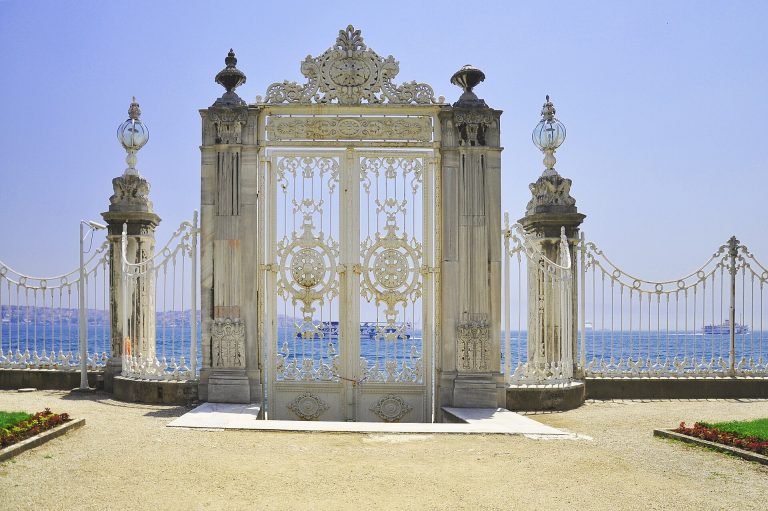
- The gardens and the Bosphorus gates: the ornate gates facing the water and the street are among the most photographed sights in Istanbul.
Visiting tips
- Closed on Mondays, and also on New Year’s Day and the first day of the two religious holidays (Ramazan and Kurban Bayramı).
- Opening times: longer in summer than in winter. In winter the ticket office usually closes in the late afternoon, so arrive by early afternoon.
- Tickets: buy at the palace or online through the official National Palaces website and app. The Museum Pass Istanbul is not valid here.
- Go early: queues can be long, especially at weekends and on 10 November.
- Allow time: two to three hours for the Selamlık, the Harem and the gardens.
Many visitors combine Dolmabahçe with a walk along the Bosphorus to Beşiktaş and Ortaköy, or with a ferry from Beşiktaş pier to the Asian side.
Getting there
- Tram T1 to Kabataş, the last stop, then a short walk along the waterfront.
- Funicular F1 from Taksim down to Kabataş.
- Ferry to Kabataş or Beşiktaş. See getting around Istanbul.
What real travellers say
- “More dazzling than Topkapı inside.” Many are surprised by the European-style splendour of the rooms.
- “Very moving.” Turkish and foreign visitors alike describe the room where Atatürk died as the most emotional moment of the visit.
- “Check the day.” A common mistake is arriving on a Monday.
Summarised in our own words from travel guides and holidaymaker reviews. We don’t list prices because they change often.
Sources we checked (November 2026): Milli Saraylar: Dolmabahçe Palace · Milli Saraylar: Dolmabahçe Sarayı (Turkish) · DHA: Atatürk’s room at Dolmabahçe (Turkish)
Dolmabahçe Palace: questions
Is Dolmabahçe Palace open on Mondays?
No. It is closed on Mondays, on New Year’s Day and on the first day of the two religious holidays.
Is Dolmabahçe included in the Museum Pass Istanbul?
No. The official palace website says the Museum Card is not valid at Dolmabahçe; buy a palace ticket instead.
Can I see the room where Atatürk died?
Yes, it is part of the palace visit. Atatürk died there on 10 November 1938 at 09:05.
How long does a visit take?
Allow two to three hours for the state rooms, the Harem and the gardens.
Header photo: Dolmabahçe Palace and its gardens. Photo: Diego Delso, CC BY-SA 4.0, via Wikimedia Commons
No visitor reviews for this place yet. Have you been here? Rate it and help other travellers.
Share your experience →Share your memories and tips with other travellers. Your story will appear on our blog with your name.