
Ani Archaeological Site: A Walking Guide to the Ghost City
A medieval capital on the Silk Road, high above the border gorge near Kars
In short: Ani is a ruined medieval city on a triangular plateau above the gorge of the Arpaçay river, which forms the border between Türkiye and Armenia, about 42 km from Kars. It was the capital of the Bagratid Armenian kingdom from 961, a Silk Road crossroads, and later ruled by Byzantines, Seljuks, Georgians and Mongols. Churches, a mosque, walls and a palace still stand on the open grassland. It has been a UNESCO World Heritage Site since 2016.
Last checked: 11 November 2026. Opening hours: check before you go. We don’t list prices.
A short history of Ani
- Early fortress: the inner citadel was first settled by the Urartians, and in the 5th century there was a fortress of the Kamsarakan family here.
- Royal capital: King Ashot III made Ani the Bagratid capital in 961. At its peak it may have had up to around 100,000 people, though historians debate the figure. It was nicknamed the “city of 1,001 churches”, although the real number was far smaller.
- Changing rulers: Byzantine rule from 1045, then the Seljuks under Alp Arslan took the city in 1064. The Shaddadid dynasty ruled after 1072, and later the city came under Georgian rule.
- Decline: the Mongols sacked Ani in the 13th century, and an earthquake in 1319, together with changing trade routes, began its long decline. It became Ottoman in the 16th century.
- Rediscovery: after Russia took the region in 1878, Nikolai Marr excavated here from the 1890s until 1917.
Walking route: what to see
- City walls and the Lion Gate: the double northern walls have three gates. You enter through the main one, the Lion Gate, with its lion relief.
- The Cathedral: begun around 989–990 under King Smbat II and completed under Queen Katranide; the inscription is read as 1001 or 1010. Its architect, Trdat, also repaired the dome of Hagia Sophia in Constantinople. The dome fell in the 1319 earthquake, and after 1064 the building was used as the Fethiye Mosque.
- Church of the Redeemer (Surp Prkich): built around 1035 by Prince Abulgharib Pahlavuni to house a piece of the True Cross. A lightning strike split it, and half of the building collapsed.
- Church of St Gregory of Tigran Honents: built in 1215 by the merchant Tigran Honents, with frescoes of the lives of Christ and St Gregory the Illuminator.
- Church of St Gregory of Abughamrents: a late-10th-century private chapel of the Pahlavuni family.
- Gagikashen: King Gagik’s round church, built around 1001–1005 to a design by Trdat and modelled on Zvartnots; it collapsed early, and only its foundations remain.
- Menüçehr Mosque: from the late 11th century; Turkish sources describe it as the first Turkish mosque in Anatolia. After restoration, the call to prayer was heard here again in 2021.
- Also look for: the 12th-century Seljuk palace with its star-patterned doorway, the piers of the old Silk Road bridge on the border river, a Zoroastrian fire temple, and the Nuns’ Monastery on the cliffs of the gorge.
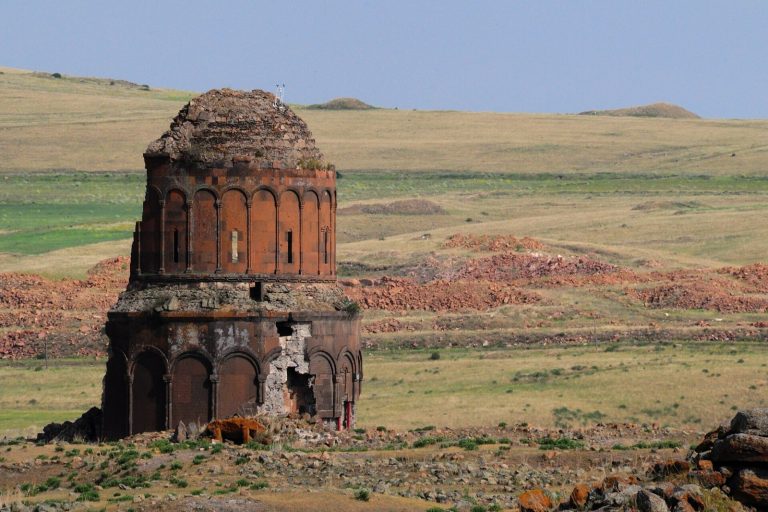
Conservation
The World Monuments Fund placed Ani on its Watch List in 1996, 1998, 2000 and 2002, and later worked with Türkiye’s Ministry of Culture and Tourism to stabilise the Cathedral and the Church of the Redeemer. Work on the Redeemer began in 2012. A visitor app in Armenian, English and Turkish was launched in 2023.
Plan your visit
- Getting there: Ani is about 42 km from Kars, reached by road.
- Best season: the site looks different in every season, with snow in winter and green grass in spring. Late spring and summer are easiest for walking around.
- Combine with: the Touristic Eastern Express to Kars and the frozen Lake Çıldır in winter.
Sources we checked (November 2026): UNESCO: Archaeological Site of Ani · Ministry museums portal: Ani · Kültür Portalı: Ani (Turkish) · Go Türkiye: Kars · Wikipedia: Ani · Wikipedia: Cathedral of Ani · National Geographic: Ani · World Monuments Fund: Church of the Redeemer · Daily Sabah: exploring Ani · Daily Sabah: Menüçehr Mosque · Courtauld Institute: Gagikashen · Lonely Planet: Ani
Ani: questions
Why is Ani called the city of 1,001 churches?
It is a traditional nickname for the medieval capital; the real number of churches was far smaller, but many still stand on the site.
How far is Ani from Kars?
About 42 km, on the Armenian border above the Arpaçay gorge.
When did Ani become a UNESCO site?
In 2016.
What should I not miss at Ani?
The Cathedral, the half-collapsed Church of the Redeemer, the frescoes of Tigran Honents, the Menüçehr Mosque and the Lion Gate.
Header photo: the Cathedral of Ani. Photo: Panegyrics of Granovetter, CC BY-SA 2.0, via Wikimedia Commons (resized).
No visitor reviews for this place yet. Have you been here? Rate it and help other travellers.
Share your experience →Share your memories and tips with other travellers. Your story will appear on our blog with your name.